
What you are still allowed to say.
Marketing has been told to stop using the word sustainable, nobody has explained precisely why, and the safest-looking response (say nothing at all) turns out to have its own costs. This page is about where the line actually is, and what has to sit behind a claim for it to stay on the right side of it.
An environmental claim is any statement suggesting a product or company is better for the environment, and across the EU and the UK the rules have converged on one requirement: the claim must be specific, and it must be substantiated by evidence before it is published. The EU’s Empowering Consumers Directive bans generic environmental claims outright, the Green Claims Directive sets what substantiation means, and the UK’s Competition and Markets Authority enforces a code with the same shape.
Evidence has to come first now.
For most of the last decade environmental marketing operated on the same footing as any other advertising: say something, and deal with a challenge if one arrives. The change now landing across Europe and the UK inverts the order. A claim must be substantiated before it is made, and the burden of proof sits with the company making it rather than with whoever doubts it.
That single reversal explains almost everything that follows. It is why vague words are now dangerous rather than merely weak: a claim too imprecise to be tested cannot be substantiated, so imprecision has moved from being a safe hedge to being the problem. It is why the interesting question is no longer whether a claim is true but whether you can show it, on demand, from records.
It also lands hardest on the claims brands are proudest of. Long-standing, comfortable, company-level statements (the kind that have been on an About page for five years) are frequently the ones with nothing behind them, precisely because nobody ever thought of them as claims.
Three instruments pointing one way.
There are three instruments a fashion brand selling into Europe and the UK needs to know about, and although they differ in mechanism they point the same way. Reading any one of them well gets you most of the way to compliance with the others.
The Empowering Consumers Directive is the blunt one: it amends EU consumer law to ban generic environmental claims where excellence cannot be demonstrated, and to restrict sustainability labels that are not based on a certification scheme or established by a public authority. It is the instrument that makes bare words like eco-friendly, green or climate neutral effectively unusable on their own.
The Green Claims Directive is the detailed one, setting out what substantiation has to consist of (the evidence, the method, the verification) for an explicit environmental claim. The UK’s Competition and Markets Authority reaches the same place by a different route: its Green Claims Code sets principles with real enforcement behind them, and its investigations into fashion retailers are the clearest published guide anywhere to how a regulator actually reads this kind of marketing.
- EU
Empowering Consumers Directive
Bans generic environmental claims and restricts self-made sustainability labels. The reason single-word claims are now a liability rather than a soft option.
- EU
Green Claims Directive
Sets what substantiating an explicit environmental claim requires: the evidence, the method, and independent verification before publication.
- UK
CMA Green Claims Code
Principles with enforcement behind them: truthful, unambiguous, complete, fairly comparable. The fashion investigations are the best published worked examples available.
- Everywhere
The display schemes
France’s environmental cost and the product passport are claims too, made by regulation. What you publish there has to agree with what your marketing says.
The words that no longer work.
A useful test before publishing anything: could a reasonably sceptical person ask what exactly you mean, and would you have a documented answer in one step? Most claims that fail the new rules fail this test in the same way: they compare against nothing, they cover the whole product when the evidence covers one part of it, or they use a word with no agreed meaning.
Comparatives are where brands trip most often, because they feel rigorous. Better, lower-impact, reduced: every one of them is a comparison, and a comparison needs a stated baseline, an equivalent functional unit and a like-for-like method. Compared with our previous season, measured cradle-to-gate on the same assessment method is a claim. Better for the planet is not.
Absolute environmental virtue is harder still. Neutrality claims in particular have moved from routine to high-risk, because they usually rest on offsetting rather than on reduction, and the two are different statements about your own footprint. Saying what you funded is straightforward and defensible; saying what it cancels is where the trouble is.
The same intention, written two ways. One of these can be substantiated and one cannot.
“Our most sustainable collection yet.” “Eco-friendly cotton.” “Climate neutral.” “Better for the planet.” No baseline, no boundary, no method, and no way for anyone to check.
Use it forNowhere, now. Each of these is either a generic claim or an untestable comparative, and both are what the current rules were written to remove.
“This jacket’s cradle-to-gate footprint is 32% lower than the equivalent style in our AW24 range, assessed on the same method, with 71% of the data measured in our own chain.”
Use it forAnywhere, because every element of it points at a record, and a challenge is answered by opening the record rather than by arguing.
What substantiating a claim actually takes.
Substantiation is less exotic than it sounds. It means the claim points at a number, the number points at a method, the method points at the evidence, and someone can walk that path without asking you for help. Where each step exists, a challenge is a half-hour of work. Where one step is missing, it is a crisis with a deadline attached.
In practice the missing step is nearly always the same one: the claim covers the product, and the evidence covers part of the product. A brand can substantiate a fibre’s certification and finds itself defending a statement about the garment. So the scope of the claim and the scope of the evidence need to be written down together, by the same people, before anything is published.
The second common gap is versioning. A claim published in a campaign lives for years; the figure under it moves when a factor is revised or better data replaces an estimate. A claim with no record of which method version it was computed on cannot be defended later, because you cannot reconstruct what you meant at the time. Keeping the basis with the figure is dull and it is what makes an old claim survivable.
None of which means retreating into silence. Saying nothing has become its own risk: retailers ask, schemes will publish a figure for you whether or not you say anything, and a brand with no substantiated claims is not a brand nobody assesses. It is one whose story is told by other people’s numbers.
- Before publishing
Write the claim and its evidence together
The scope of the words and the scope of the assessment settled by the same people, in the same document, before a designer sees it.
- Before publishing
Name the comparison
Against what, on what functional unit, on what method. A comparative without all three cannot be substantiated by anything.
- Before publishing
Check the boundary matches the words
A cradle-to-gate figure cannot support a claim about a product’s whole life. This is the single most common mismatch.
- Keep
The method and dataset version
So that a claim made in 2026 can still be explained in 2029, when the factors behind it have moved on.
- Keep
The measured share
How much of the figure was measured and how much estimated. Stating it is what turns a challenged claim into a conversation.
Everything this page defined.
In the order you met them, in case you came back for one of them rather than for the whole page.
- Environmental claim
- Any statement implying a product or company is better for the environment. Broader than most teams assume: it includes imagery and implication, not only text.
- Generic claim
- An environmental claim with no specified scope or evidence, such as “eco-friendly”, “green”. Banned in the EU where excellence cannot be demonstrated.
- Substantiation
- Having the evidence, the method and the verification behind a claim before it is published, rather than assembling them if challenged.
- Comparative claim
- Any claim of better, lower or reduced. Needs a stated baseline, an equivalent functional unit and a like-for-like method.
- Greenwashing
- A claim that conveys more environmental benefit than the evidence supports. Usually a scope mismatch rather than an invention.
The shorter answers live on the FAQ.
Each of these is answered in a paragraph on the FAQ, which is where those answers live. This page is the long version of the same subject.
Hear it from the people who teach it.
This is the subject our library is longest on: twelve years of sessions on communication and marketing, and the two guides that answer it directly. The guides are the deeper asset; the argument is here, in front of you, either way.
 Going Beyond Greenwashing GuideHow to make a claim that is both correct and legal, with the checklist to run before anything is published. The most directly useful thing we have on this.→
 A Guide to Green MarketingTen tips you can act on this week, with worked examples from brands already telling their story straight.→
 Communicating Sustainability: Transparent, Compliant MessagingAkhil Sivanandan with Professor Anne Peirson-Smith and Dr Alana James on bridging compliance and creativity, including best and worst practice from the industry, named.→
 Communicating Responsibly: Crafting Clear and Compelling Narratives for Effective Corporate Climate MessagingCorporate climate messaging specifically, which is where the oldest and least-examined claims usually live.→
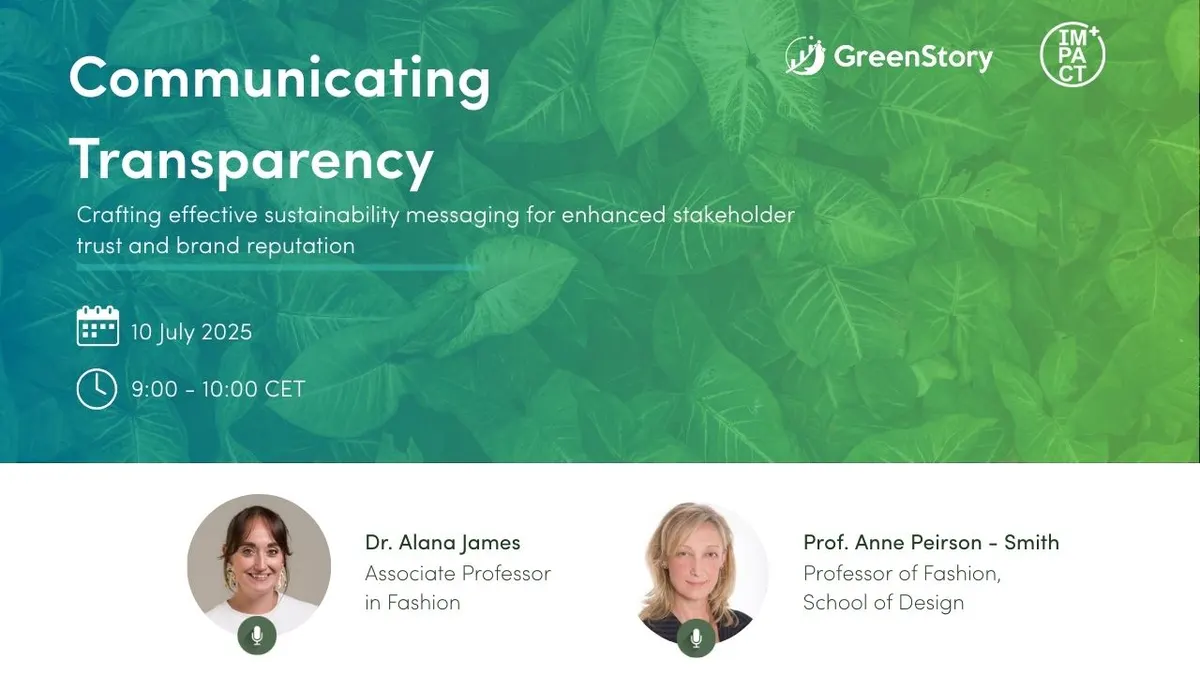 Communicating Transparency: Crafting Effective Sustainability Messaging for Enhanced Stakeholder Trust and Brand ReputationThe most recent session on this subject in the library, and the one closest to the rules as they now stand.→
 How to ensure accurate impact measurement of your products in compliance with anti-greenwashing legislationMeasurement and anti-greenwashing legislation taken together, which is the order the law now requires you to think in.→
 Sustainable fashion communication and green marketingThe longer view: what has and has not worked in this industry’s environmental marketing.→
We are not your lawyers and we will not sign off your copy. What we can do is make a claim checkable: the figure, the method, the evidence and the version behind it, assembled so that answering a challenge is a search rather than a scramble. Where a claim you want to make is wider than the evidence we hold, we will say so before it is published rather than after, and that conversation is more useful in a planning meeting than in a regulator’s letter.
The same subject from another side.
- Compliance on the platformReadiness framework by framework, with the evidence and the graded gaps behind each one.→
- What a product LCA measuresThe boundary question underneath most claim mismatches: what the figure covers, and what it does not.→
- France’s environmental costWhere a regulator makes the claim for you, and your marketing has to agree with it.→