
Everything a fashion brand has to prove, in one system.
Comprehensive features ensure all jobs on your team’s desk read from one dataset, so the numbers agree with each other.
A 30-minute call. Bring one style and one supplier, and we show you the real output.







The brands already running it.
“Green Story are unique in that they offer a complete service for Life Cycle Assessments, that includes valuable support in data collection and analytical expertise but beyond this, integrates the results of these studies into content that is meaningful to our customers and internal teams. For businesses seeking to make a positive difference, Green Story is a valuable partner to have!”
“We're proud to be ahead of the curve. Working with Green Story, we've built a foundation not just for transparency—but for smarter product development and real carbon reduction.”
“There's lots of great projects going on at Leo and the data provided by Green Story was a huge help in reporting with Positive Planet!”
Walk the path a brand actually walks.
All jobs, three phases, one dataset underneath. Move along the path to see what you do at each stop and what comes out of it.
Find out who actually makes your product
The supplier list stops at tier 1, and the retailer is asking which mill dyed this order.
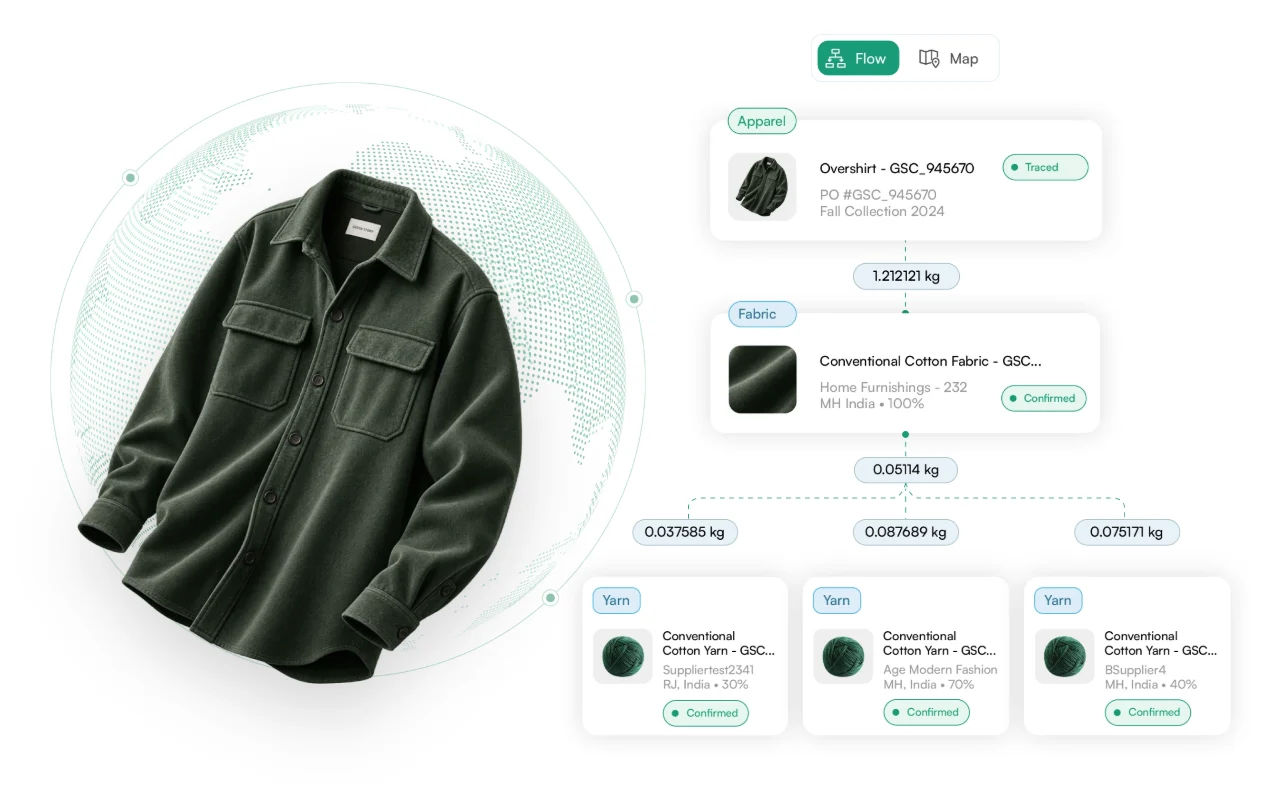
- Raise a trace from a purchase order
- Each partner confirms their own link
- Our analysts verify on site
A chain each partner has confirmed themselves, with the gaps named rather than smoothed over.
- Tier 1–4 chain map
- Gaps graded critical to optional
- Evidence pack per supplier
- Supply chain mapping
- Order-to-origin tracing
- Supplier onboarding & portals
- Multilingual data ingestion
- Document & evidence collection
- Offline suppliers
- Data gap analysis
- On-site & online verification
All features included.
Unlimited products, passports and ecoscores. Nothing here is a module bought separately, and nothing is priced per SKU. Open a group to read what each one does.
Traceability & supplier data
- Supply chain mapping
- Order-to-origin tracing
- Supplier onboarding & portals
- Multilingual data ingestion
- Document & evidence collection
- Batch & product-level capture
- Offline suppliers
- Data gap analysis
- On-site & online verification
- Primary data collection
Product footprints & LCA
- Product LCAs, ISO-aligned
- Product carbon footprints
- Order- and SKU-level footprints
- Product library
- Fibre & material library
- Process-level LCA
- PEF & ecoscore calculations
- French ecoscore publishing
- Custom emission factors
- Measured-vs-estimated disclosure
- Hotspot analysis
- Expert-led data validation
Ecodesign & product development
- Scenario modelling
- Material comparisons
- Process & mill comparisons
- Real-time design impact
- Circularity & end-of-life modelling
- Insetting opportunities
- Ecodesign insights
Corporate footprint, targets & decarbonisation
- Scope 1, 2 & 3 accounting
- Scope 3 from product LCAs
- Scope 3 category mapping
- GHG Protocol & ISO 14064
- SBTi target setting & tracking
- Decarbonisation pathways
- Reduction scenario modelling
- Supplier scorecards
- Supplier engagement & training
- B Corp & reporting inputs
- CSO-led roadmapping
Eco-contributions & offsetting
- Vetted project portfolio
- Verified credit standards
- Plastic & biodiversity credits
- Insetting projects
- Per-product contributions
- Credit retirement tracking
- Priority alignment
- Customer contribution journey
- Third-party-supported claims
Compliance, standards & assurance
- Compliance readiness by framework
- AGEC & ESPR readiness
- PEFCR & Ademe alignment
- ISO 14067, EPD & PEF footprints
- Higg verification support
- Supplier questionnaires
- Supplier risk
- Audits & corrective actions
- Toxic substance disclosure
- Compliance-ready documentation
- Evidence review & interpretation
- Regulations tracker
DPP, transparency & marketing
- DPP generation, GS1 & API
- Custom DPP templates
- QR code integration
- Product sustainability widgets
- CMS & e-commerce embedding
- Email campaign integration
- Relatable impact metrics
- Consumer supply chain maps
- Recyclability & composition
- Marketing strategy support
- Ready-to-use campaign templates
- Sales & impact
Platform, data & the expert layer
- Command center
- AI with human approval
- Documents & certificates
- Business reporting
- Automated report generation
- Drill-down to source document
- Trusted data exchange
- Data hierarchy
- Published methodology
- Dedicated analyst
- Ongoing expert guidance
- Unlimited products & DPPs
Built for fashion, footwear and home textiles.
Designed for the realities of textile supply chains: complex materials, fragmented supplier data, multiple production tiers, evolving regulations, and fast-moving product teams.
- 200+companies
- 35+countries
- 1,000+LCAs delivered
- 100k+products assessed
Before the feature list, the obvious ones.
What is Green Story?
Green Story is a sustainability data company for the global fashion industry. It turns scattered product and supply-chain data into life-cycle assessments, digital product passports, ecoscores and compliance-ready reporting, combining an AI-first platform with named experts led by a published chief scientist.
The company was founded in 2015 and works with more than 200 companies across 35+ countries, from billion-dollar household names to companies on the cutting edge of sustainable innovation.
Which standards does Green Story's data conform to?
Green Story's life-cycle work follows ISO 14040/44, ISO 14067 and the EU PEF method. Corporate inventories follow the GHG Protocol and ISO 14064. Passports are built to GS1 identification standards and the CIRPASS-2 programme, and the French environmental cost display is computed on its own published method.
The frame changes the presentation, never the underlying figure, which is why a number quoted into one framework is the number quoted into the others.
What does the Green Story platform do?
Green Story covers traceability, product LCA, ecoscore, carbon accounting, SBTi targets, eco-contributions, compliance, digital product passports and reporting. All of them read from one traced dataset, which is why a figure quoted in one is the figure quoted in the others.
The facts are collected once, against the purchase order that actually made the garment, and each framework is a presentation of them rather than a separate collection exercise.